

Connectors
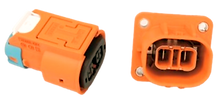
High voltage connectors
High-voltage connectors play a fundamental role in modern electrical systems, especially in demanding sectors such as electric vehicles (EV), energy management infrastructures and industrial electronics.
These connectors are designed to ensure reliable performance, optimum safety and compatibility with complex technical environments.
Etronics offers a wide range of innovative solutions that meet the most stringent requirements in terms of current, voltage, insulation resistance and protection against electromagnetic interference.
The voltage ranges of our high voltage connectors in electric vehicles are between 300V and 1000V, with current ranges from 20A to 500A . The number of positions varies from 1 to 6 POS , and general requirements include shielding and interlocking functions.
For more information, please see our documentation:


How to choose a connector?
The choice of a high-voltage connector depends on several essential criteria to ensure optimal performance and enhanced safety. Here are the main points to consider:
Rated current and voltage: Ensure that the connector can handle the current and voltage levels required for your application. For example, for high-power applications, opt for models like the REG1 or REN1, which can manage up to 1000 V DC and high currents.
Environmental conditions: The connectors must be suited to specific environments (temperature ranges, humidity, vibrations, etc.). Options like the MSD2 or MINI-S50/S70 are designed to operate between -40 °C and +125 °C, with excellent vibration resistance.
Safety standards: Check compliance with IP standards (protection against dust and water) and HVIL systems to prevent any risk of error or failure.
Mechanical and electrical durability: Choose connectors that offer high mechanical strength, electrical robustness (insulation resistance, withstand voltage), and extended lifespan, particularly for mating cycles.
Compatibility with cables and systems: Ensure that the selected connector is compatible with the cable cross-sections and the specifications of the systems it will be integrated into.
What types of connectors?
Manual Service Disconnector (MSD2)
The MSD2 is designed to ensure safe manual disconnection in high-voltage systems. It operates within a temperature range of -40 °C to +125 °C and withstands a relative humidity of 95% at 40 °C. The device resists vibrations from 10 to 55 Hz with an amplitude of 0.75 mm and mechanical shocks of 980 m/s². The locking handle can withstand a retention force of at least 200 N.
MINI-S50/S70 Connector
This connector is suitable for rated currents of 200 A with 50 mm² cables and 250 A with 70 mm² cables, for a rated voltage of 750 V DC. It offers an insulation resistance greater than or equal to 5000 MΩ. Shielding and the HVIL (High Voltage Interlock Loop) system are available as options. It operates within a temperature range of -40 °C to +125 °C.
REMIII Connector
The REMIII model is a 2-position plastic connector, designed for currents ranging from 16 A to 40 A and a rated voltage of 1000 V DC. It features a locking handle and a secondary locking structure, with an error-proof design (IPXXB). The protection rating is IP6K9K/IP68, and it is compatible with 2.5 mm² cables.
HV REMII Connector
This connector supports nominal currents of 16 A (2.5 mm² cable), 25 A (4 mm²), and 40 A (6 mm²), with a nominal voltage of 700 V DC. It withstands a voltage of 3000 V AC for 1 minute and offers an insulation resistance of 3000 MΩ. Shielding and the HVIL system are optional
REL2 Connector
"The REL2 is a 4-position plastic connector, designed for currents of 16 A (2.5 mm²), 25 A (4 mm²), and 40 A (6 mm²), with a nominal voltage of 1000 V DC. Shielding and the HVIL system are available as options. It operates in a temperature range from -40°C to +140°C."
REL Connector
This connector is available in 2 or 4 position configurations, supporting currents of 16 A (2.5 mm²), 25 A (4 mm²), 40 A (6 mm²), and 60 A (10 mm²), with a nominal voltage of 1000 V DC. Shielding and the HVIL system are optional, and it is designed to operate between -40°C and +140°C.
RS4 Connector
The RS4 is intended for battery management systems and other signal control systems for EVs. It supports a voltage of 300 V DC and a current of 7 A, with 12 or 18 position configurations. Shielding and the HVIL system are optional.
REQ4 Connector
This metal connector is designed for a nominal voltage of 1000 V DC, with a contact resistance of less than or equal to 3 mΩ. It withstands a voltage of 3000 V AC for 1 minute and offers an insulation resistance of greater than or equal to 3000 MΩ (at ≤40°C, ≤50% RH) or 300 MΩ (at >95% RH). The mating cycle is 20 times.
REN1 Connector
The REN1 is a 2-position connector, supporting currents of 80 A (16 mm²) and 125 A (25 mm²), with a nominal voltage of 1000 V DC. Shielding and the HVIL system are optional, with an operating temperature range from -40°C to +140°C.
REG1 Connector
The REG1 is designed for currents ranging from 120 A to 250 A, with a nominal voltage of 1000 V DC. It withstands a voltage of 5000 V AC and offers an insulation resistance of 5000 MΩ/1000 V DC. Shielding and the HVIL system are available as options.
Manual Service Disconnector (MSD7)
The MSD7 is designed for applications requiring a secure manual disconnection. It supports a fuse current of 200 A to 400 A for a voltage of 750 V DC, and up to 500 A for a voltage of 500 V DC. The nominal current is 250 A.
Battery Swap Connector
This connector is ideal for battery replacement applications. The PFSC-TQA-BS1270 and PFSC-TQA-CP1270 models support a nominal current of 300 A and a nominal voltage of 750 V DC. Shielding and the HVIL system are optional, with an operating temperature range of -